HAWK: Airplane Space games
- 4.3
- Rating
- 10.00M
- Installs
- Free
- Price
 Analysis by App-foxy
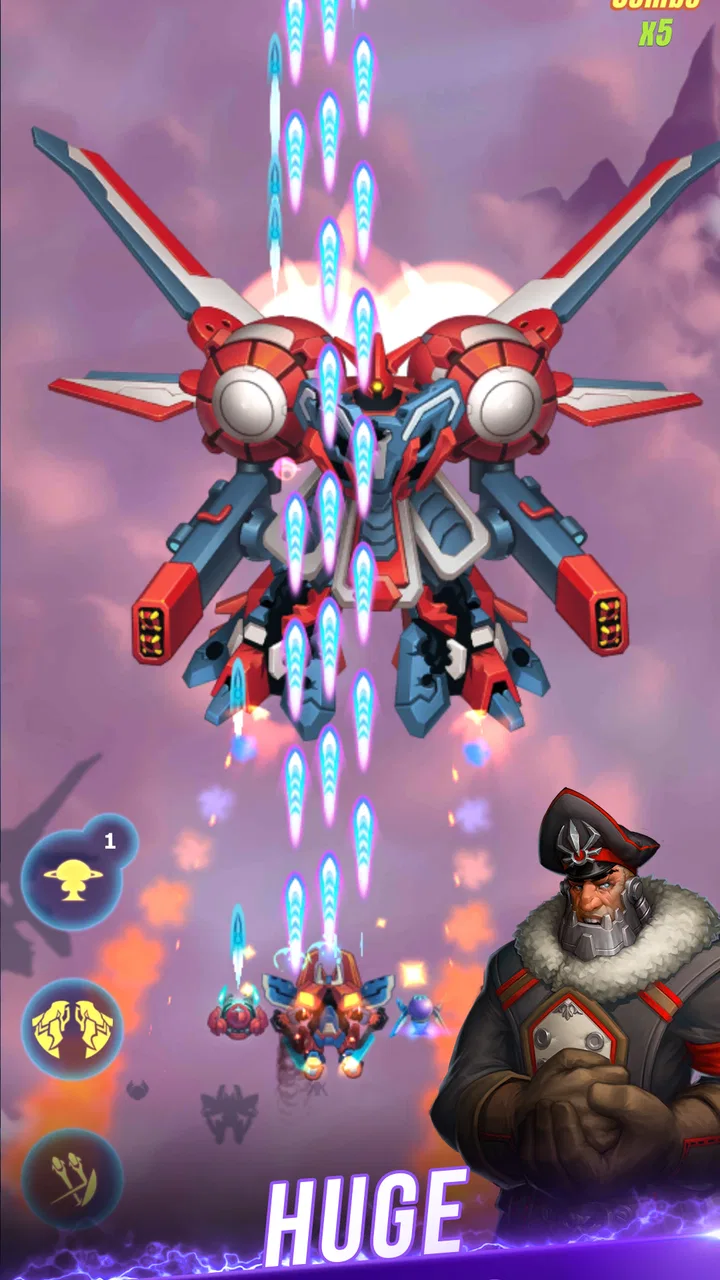
I first picked up HAWK: Airplane Space games expecting a quick arcade shooter, and that is still the easiest way to understand its appeal. It puts you in control of a combat aircraft, sends you into busy battles, and asks you to survive long enough to bring down powerful bosses. The difference is that it also works well as a shared game: one person can play a short session, then hand the device to someone else, while friends can join the fight when cooperation matters more than individual score.
That makes it an interesting choice for a household with one tablet or a phone that gets passed around. I would not describe it as a quiet, relaxing game, because the screen can become crowded and the action demands attention. Still, it is easy to understand within a few minutes, free to start, and broad enough to appeal to players who enjoy arcade shooting without wanting a complicated simulation. My experience was strongest when I treated it as a game of short, focused sessions rather than something to leave running in the background.
What playing HAWK feels like on a shared device
The basic attraction is immediate: move the aircraft, avoid danger, fire at enemies, and keep enough control to reach the boss encounter. That familiar structure makes it suitable for a quick turn after school, during a break, or while waiting for another family member to finish using the device. A younger player can understand the objective quickly, while an experienced arcade fan can look for better movement, cleaner dodges, and more efficient attacks.
You May Also Like

 Blood Strike: 2.5 Anniversary
Blood Strike’s Loadouts Turn Every Drop Into a Tactical Gamble
A close look at Blood Strike’s custom loadouts: how fast access to signature weapons reshapes its battle royale rhythm, rewards preparation, and narrows the gap between fights.

 Pandora - Music & Podcasts
Pandora’s Music Is Easy to Start, but Harder to Recover
Pandora’s strength is its low-effort path from a seed to a station. Its weak spot is how much confidence it asks you to place in connection, setup, and quiet recovery.

 8 Ball Pool
 Is Built on Rivalries, Rematches, and Routine
A close look at the rivalries, rematches, shared routines, and unanswered safety questions that turn a quick pool match into a persistent mobile community.

 Samsung Music
’s Quiet Strength Is Playing What You Already Own
Its reach comes less from spectacle than from dependable access to a personal library. That simplicity is both the app’s strongest retention engine and its ceiling.

 AccuWeather: Weather Radar
AccuWeather Review: A Quick, Clear Forecast for Everyday Decisions
For everyday plans, the best forecast is the one you can understand quickly. AccuWeather makes rain timing, radar, and local conditions easy to act on, with a few trade-offs.

 Hill Climb Racing
Why Hill Climb Racing Still Turns Crashes Into One More Run
A tiny car, a bumpy hill and one more upgrade: Hill Climb Racing keeps resurfacing because its simple chaos makes every near-miss feel personal.
More From Our News Desk



In a shared-use situation, I found it helpful to decide in advance whether the game was being played as a personal progression experience or as a group activity. Those are different expectations. If everyone takes turns on the same device, progress and upgrades can become a source of disagreement unless players agree whose session is active. If the group is coordinating online with friends, the game feels more social, but each person still needs to understand what they are responsible for during a battle.
The boss-focused design gives a natural stopping point. A player can aim to finish a stage or make a serious attempt at a boss rather than playing indefinitely. That is useful in a household because it creates a reasonable moment to hand over the phone. I would still avoid promising a child that a session will last exactly a certain amount of time; the length and intensity of a run can vary depending on how far the player gets and how much attention the battle requires.
One practical tip is to use the first few sessions to learn movement before worrying about spending resources. In arcade shooters, a player who panics and moves constantly can be less effective than one who watches patterns and leaves room to escape. With HAWK, that mindset matters especially when the screen becomes busy. Saving a safe route through the action is often more valuable than chasing every target immediately.
Starting without creating household confusion
The game is free, which lowers the barrier for trying it on an Android or iOS device. It comes from KEYSTORM HOLDINGS LTD and belongs to the arcade category, so the presentation is built around immediate action rather than a slow tutorial or a long story introduction. It was released on May 15, 2017, and supports devices running Android 6.0 or later. On a shared device, I would check the operating-system requirement before planning a family session, particularly if the phone or tablet is older.
The most important setup boundary is financial rather than technical. HAWK includes optional in-app purchases ranging from $0.99 to $114.99 per item. That is a very wide range, and it is the kind of detail adults should discuss before letting children play on a device connected to a payment method. I would not hand over the phone with the assumption that “free” means there is no purchase risk. The game can be tried without paying, but the purchase environment deserves clear household rules.
For a shared device, I would establish three simple habits. First, nobody buys anything without asking the device owner. Second, players say whose progress they are using before starting. Third, the next person does not alter another player’s choices just to test something. These are not game features; they are practical boundaries that prevent a free-to-start arcade title from becoming a source of arguments.
I also recommend keeping the device charged and using a stable connection when the household plans to coordinate with friends. I would not build a family routine around a single long session. Short turns are easier to supervise, easier to compare fairly, and less likely to end with someone feeling that another player took over the entire game.
Another useful approach is to separate experimentation from serious progress. A player can use one turn to learn how movement and attacks feel, then reserve another turn for a more careful attempt. That distinction is valuable when several people share a device because it makes failure less frustrating. Nobody has to treat the first attempt as a permanent test of skill.
Why coordination changes the experience
The central social idea is cooperation against bosses. That changes the tone from a purely solitary score chase into something closer to a team challenge. When I played with coordination in mind, communication became more useful than simply telling another player to “shoot more.” The better conversation is about who is watching which part of the screen, when someone should play cautiously, and whether the group is trying to survive or push for faster damage.
For friends playing together, a short plan before entering a difficult encounter can make the session feel much more organized. One player might focus on staying alive and drawing attention away from danger, while another takes advantage of openings. I would avoid turning that into a rigid role system unless the group naturally enjoys it. The important point is that cooperation works best when players stop duplicating the same movement and start paying attention to the whole battle.
This is also where HAWK differs from a standard solo arcade alternative. A traditional single-player shooter can be easier to understand because every decision belongs to one person. HAWK is more appealing when friends enjoy shared goals, but coordination adds friction: people need compatible schedules, a reliable connection, and enough patience to recover from a failed attempt. If you prefer a completely self-contained game that never depends on another player, a conventional offline arcade title may suit you better.
There is a subtle trade-off in cooperative play. A strong teammate can make a difficult encounter feel approachable, but that can also hide weaknesses in a newer player’s technique. I think the best household use is to alternate between supported runs and independent attempts. A child or beginner can learn by following a more experienced player, then try again alone to see which movements they actually understand.
When coordinating with friends, I would keep voice or text communication focused. Too much commentary can distract from the action, especially during a boss sequence. Simple calls such as “stay left,” “wait,” or “I need space” are more useful than constant instructions. This is one of the non-obvious strengths of the game’s format: cooperation is not only about dealing damage; it is about reducing confusion on a crowded screen.
Age context, trust, and supervision
HAWK carries an Everyone 10+ content rating. That makes it more suitable for older children, teenagers, and adults than for very young players, although the right choice still depends on the individual child. The main concerns in a household are likely to be fast action, frustration during difficult battles, interaction with other players, and the possibility of in-app purchases rather than realistic violence or complicated subject matter.
I would let a child try it first while an adult is nearby, not because the controls are mysterious, but because the pace can encourage impulsive decisions. A player who loses repeatedly may start asking for upgrades without understanding what they are buying. The conversation should happen before the frustration starts: explain that progress does not require an automatic purchase and that asking for help is part of the session.
Trust also matters when friends are involved. I would encourage children to use only the communication they need for the game and to avoid sharing personal information. The game’s cooperative angle can make players feel familiar with people they have never met, so ordinary online caution still applies. Adults should make the boundaries clear without presenting every match as dangerous; the goal is confident, sensible use.
For a family, I would not assume that one person’s comfort level applies to everyone else. A teenager may enjoy intense boss battles, while a younger sibling may find the same screen overwhelming. Taking turns lets each player decide how much action feels manageable. It also gives adults a chance to notice whether the game is being enjoyed as a challenge or simply causing repeated irritation.
The age rating should also be considered alongside the purchase range. A game can be appropriate in theme and still require adult involvement around spending. In my view, that is the clearest household rule for HAWK: children may play, but purchases should remain an adult decision. If a family cannot maintain that boundary on a shared device, I would choose a game with no purchase pathway instead.
Progress, difficulty, and smart session habits
The most rewarding way to approach HAWK is to treat each run as practice, not just as a demand for immediate success. Bosses expose habits quickly. If I keep moving into danger, upgrading alone will not solve the problem. Watching attack patterns, keeping an escape route open, and learning when not to chase a target are skills that carry from one encounter to the next.
That leads to a useful trade-off for players deciding whether to spend money. Optional purchases may feel tempting when progress slows, but they can also remove the satisfaction of learning the encounter. I would first repeat the stage with a more careful movement plan. If the obstacle is genuinely a lack of equipment rather than poor control, a player can then make a more informed decision. The key is not to buy while annoyed after a defeat.
On a shared device, players should be careful with upgrades and other progression choices. Even without inventing a separate family-profile system, the practical issue is obvious: one person’s decisions may affect everyone using that save or account. I would take a moment to identify the active player before confirming anything important. Screenshots or notes can also help a household remember which aircraft or strategy someone was working toward, though they do not replace a clear agreement.
Another advanced habit is to review why a run failed instead of only counting how far it went. Did the player lose because movement became too wide, because they stayed near a dangerous edge, or because they ignored incoming threats while attacking? This turns a short arcade session into useful practice. It is especially effective for children because it teaches them to adjust a strategy rather than immediately blaming the game.
The game’s scale is also worth considering. With an average rating of 4.3 from around 331 thousand ratings and more than 10 million installs, it has clearly reached a large audience. Those figures suggest that the basic concept connects with many players, but they do not guarantee that every household will enjoy the same pace or purchase structure. I would use the popularity as a reason to try it, not as a substitute for checking whether its style fits the person holding the device.
Who should choose it, and who should skip it
I would recommend HAWK to someone who wants an accessible arcade shooter with boss battles and a cooperative angle. It is a particularly good fit for friends who enjoy comparing attempts, helping a newer player, and coordinating under pressure. It can also work for a family that shares a tablet and is willing to set clear turn-taking and spending rules.
I would be more cautious about recommending it to someone seeking a calm game, a deep simulation, or a completely private offline experience. The action is the point, so players who dislike screen clutter or repeated attempts may lose patience. It is also not my first choice for a young child who cannot yet understand purchase boundaries or who becomes upset when a difficult encounter ends a run.
Compared with a typical solo arcade game, HAWK offers more social value when friends are available, but it asks more from the group. Compared with a competitive shooter, its cooperative boss focus can feel friendlier because the goal is shared success rather than defeating one another. Compared with a premium game bought once, its free entry is convenient, yet the in-app purchase range means adults need to pay closer attention to the device’s payment setup.
The Android requirement of version 6.0 or later is modest by current standards, but compatibility is still worth checking on an older household device. The age rating is Everyone 10+, and the game is free to download, so the initial decision is simple. The harder decision is whether the family is comfortable with the combination of fast action, cooperative play, and optional spending.
My household verdict after playing
My final impression is positive, with one firm condition: HAWK works best when the household treats it as a shared activity with boundaries, not as an unattended free game. The aircraft combat is easy to approach, the boss encounters give sessions a purpose, and cooperation adds a reason to return with friends. I especially like the way a stronger player can help a beginner learn movement and timing without turning the game into a lecture.
At the same time, I would not ignore the friction. Shared progress can become confusing, online coordination requires more organization than solo play, and the purchase range is too broad to leave unexplained on a family device. Those issues do not ruin the game, but they do determine whether it is a comfortable choice for a particular household.
My recommendation is to try it free, agree on account and spending boundaries first, and use short turns to learn the combat. If your group enjoys cooperative arcade action and can communicate calmly during boss fights, HAWK has enough energy to become a regular shared game. If you want a quiet, self-contained experience with no purchase discussion, I would choose a simpler alternative instead.
For the right players, this is more than a quick shooter: it is a compact test of movement, patience, and teamwork. I would install it for friends or family members aged ten and above who enjoy action games, while keeping an adult involved in the financial and shared-device decisions. That balance lets the game’s strongest feature—working together against a powerful boss—stand out without allowing the surrounding practical issues to take over.
FAQs for HAWK: Airplane Space games
01What is HAWK: Airplane Space Games about?
HAWK: Airplane Space Games is a fast-paced vertical shoot ’em up in which you pilot powerful aircraft through enemy-filled stages. The game combines classic arcade action with modern progression systems, including different planes, weapons, companions, upgrades, and special abilities. Missions usually involve continuous shooting, avoiding projectiles, defeating large waves of enemies, and facing challenging bosses. It is designed for short sessions but also offers long-term progression.
02Can HAWK: Airplane Space Games be played offline?
Some parts of HAWK may be available without a constant internet connection, but the game is primarily designed as an online experience. Features such as account synchronization, events, leaderboards, multiplayer activities, advertisements, purchases, and certain rewards may require internet access. If you plan to play while traveling or without mobile data, it is best to test the game after installation, since offline functionality can vary depending on the version and device.
03Is HAWK: Airplane Space Games free to download and play?
HAWK: Airplane Space Games is generally free to download, allowing players to begin the campaign without paying an upfront purchase price. However, it includes optional in-app purchases and may use advertisements or time-based systems to support progression. Spending money is not always necessary, but purchases can provide extra resources, faster upgrades, or additional advantages. Parents should review the device’s purchase settings before allowing children to play.
04Does HAWK include multiplayer or competitive modes?
Yes, HAWK offers more than a traditional solo arcade campaign. Depending on the current version and available events, players can encounter cooperative activities, team-based features, competitive challenges, rankings, and other modes that encourage interaction with other pilots. These features add variety and replay value, although they may depend on an active internet connection and may become more demanding as opponents and missions grow stronger.
05What devices are recommended for playing HAWK smoothly?
HAWK can run on many modern Android and iOS devices, but performance depends on the phone or tablet’s processor, memory, operating-system version, and available storage. A newer mid-range or high-end device is recommended for smoother animation, quicker loading, and fewer frame-rate drops during crowded battles. Keeping the game updated and closing unnecessary background apps can also help, while older devices may need reduced graphics settings if those options are available.
Pros
- Fast-paced aerial combat with responsive controls.
- Wide range of aircraft and weapons to unlock.
- Colorful visuals and impressive enemy designs.
- Frequent missions offer varied combat objectives.
- Playable offline for convenient gaming anywhere.
Cons
- Energy limits can interrupt longer play sessions.
- Upgrades may require significant grinding or spending.
- Some battles feel repetitive after extended play.
- The screen can become crowded with projectiles.
- Progression may feel slow without premium resources.

HAWK: Airplane Space games
Gallery